
In industrial equipment that requires continuous rotation, transferring electrical power and signals between stationary and rotating components can be challenging. A Through Bore Slip Ring provides a practical solution by allowing cables, shafts, pipes, or other mechanical components to pass through its central opening while maintaining electrical connections during rotation.
Also known as a hollow shaft slip ring or through hole slip ring, this type of rotary electrical connector is widely used in industrial automation, packaging machinery, rotary tables, robotics, and other rotating equipment. Understanding its structure, operating principle, and selection requirements can help equipment manufacturers and industrial buyers choose the right solution for their applications.
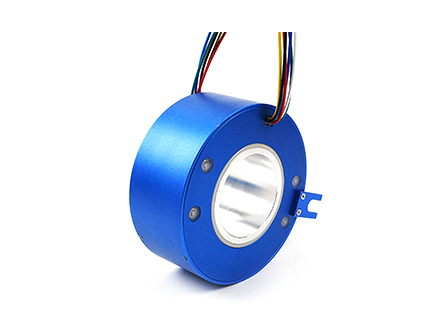
1. What Is a Through Bore Slip Ring?
A through bore slip ring is an electromechanical device designed to transmit power and electrical signals between stationary and rotating parts. Its main characteristic is a hollow central shaft that allows other components to pass through the center of the slip ring.
Unlike solid-shaft designs, the hollow structure provides additional installation flexibility. Engineers can integrate the slip ring around an existing shaft or use the central opening for routing cables, pneumatic lines, hydraulic pipes, or mechanical components, depending on the equipment design.
For machinery manufacturers, a through bore slip ring can simplify equipment integration, reduce installation limitations, and support more compact rotary systems.
2. Main Components and Working Principle
A typical through bore slip ring consists of several key components that work together to maintain electrical transmission during continuous rotation.
Rotor
The rotor is the rotating part of the slip ring. It is connected to the rotating equipment and carries conductive rings that provide electrical pathways.
Stator
The stator remains stationary while the rotor turns. It supports the electrical contact components and connects to the stationary side of the electrical system.
Conductive Rings and Brushes
Conductive rings are arranged along the rotating structure, while brushes maintain contact with the rings. This sliding electrical connection allows power and signals to pass between stationary and rotating components.
Insulation and Housing
Insulating materials separate individual electrical circuits, helping prevent short circuits and maintain electrical performance. The housing protects internal components and supports the overall mechanical structure.
3. Key Design Features of Through Bore Slip Rings
Hollow Shaft Structure
The central opening is the defining feature of a through bore slip ring. It allows the device to be installed around an existing shaft or provides space for cables and other components to pass through the center.
Flexible Installation
Through bore slip rings are available in different bore diameters, outer dimensions, mounting configurations, and connection arrangements. This flexibility makes them suitable for various industrial equipment layouts.
Multi-Circuit Transmission
Depending on the design, a through bore slip ring can transmit multiple electrical circuits simultaneously. Some configurations can also support the transmission of control signals and data alongside electrical power.
Continuous Rotary Connection
By maintaining electrical contact between rotating and stationary components, the slip ring supports continuous rotation without requiring cables to twist or become tangled during operation.
4. Common Applications of Through Bore Slip Rings
Industrial Automation Equipment
Automated production lines often use rotating platforms, indexing tables, and rotary positioning systems. Through bore slip rings help transfer power and control signals to rotating sections of these machines.
Packaging and Filling Machinery
Rotary packaging and filling machines require reliable electrical connections between stationary control systems and rotating assemblies. A hollow shaft design can provide convenient space for mechanical structures and cable routing.
Robotics and Rotary Tables
Robotic systems and rotary tables may require multiple electrical circuits for motors, sensors, and control devices. Through bore slip rings can support these connections while allowing the mechanical shaft to pass through the center.
Wind Turbines and Heavy Equipment
Some wind turbine systems and large rotating machines use slip rings to transmit electrical power or signals between stationary and rotating sections. The appropriate design depends on operating speed, electrical requirements, environmental conditions, and installation space.
5. Through Bore Slip Rings vs. Capsule Slip Rings
Through bore and capsule slip rings are designed for different installation requirements. Understanding their structural differences helps buyers identify the more suitable solution.
| Comparison | Through Bore Slip Ring | Capsule Slip Ring |
|---|---|---|
| Structure | Hollow central shaft | Compact enclosed structure |
| Installation | Can be installed around a shaft | Typically installed in limited spaces |
| Central Opening | Available in different bore sizes | Usually no large central opening |
| Typical Applications | Rotary tables, automation equipment, machinery | Compact rotary devices and instruments |
The right choice depends on the available installation space, shaft arrangement, circuit requirements, and mechanical configuration of the equipment.
6. How to Choose the Right Through Bore Slip Ring
When sourcing a through bore slip ring for industrial equipment, buyers should evaluate several technical parameters before placing an order.
Bore Diameter and Overall Dimensions
The inner diameter must match the shaft or component passing through the slip ring. Buyers should also confirm the outer diameter, overall length, mounting space, and connection position.
Electrical Circuits and Current Rating
Determine the number of circuits, operating voltage, current rating, and whether the slip ring needs to transmit power, control signals, or data. These requirements directly affect the internal structure and electrical configuration.
Operating Speed
Different machines operate at different rotational speeds. The slip ring should be selected according to the actual operating speed and duty cycle to ensure suitable mechanical and electrical performance.
Working Environment
Temperature, humidity, dust, vibration, and other environmental conditions may affect slip ring performance. For demanding industrial environments, buyers should discuss suitable housing materials, sealing options, and protection requirements with the manufacturer.
Service Life and Maintenance
Contact materials, mechanical design, operating conditions, and maintenance practices can all influence service life. Buyers should confirm expected operating conditions and maintenance requirements when evaluating a supplier.
7. Custom Through Bore Slip Ring Solutions
Standard through bore slip rings may not meet every equipment manufacturer's requirements. For applications with special shaft dimensions, multiple circuits, specific signal types, or limited installation space, a custom slip ring solution may be more appropriate.
When discussing an OEM or ODM project with a slip ring manufacturer, prepare the following information:
Required bore diameter and outer dimensions
Number of electrical circuits
Operating voltage and current for each circuit
Required rotational speed
Signal transmission requirements
Operating temperature and environmental conditions
Mounting method and cable exit direction
Expected service life and operating duty cycle
Providing these details helps the engineering team evaluate the application and recommend a suitable configuration. A professional custom slip ring manufacturer should also be able to discuss design feasibility, sample development, testing, and production requirements.
8. What to Look for in a Through Bore Slip Ring Manufacturer
Choosing a reliable supplier involves more than comparing product dimensions and quotations. Industrial buyers should consider the manufacturer's engineering capabilities, product quality control, and ability to support long-term supply requirements.
Engineering experience: Check whether the supplier understands different rotary electrical connection requirements and can support custom designs.
Product testing: Ask about electrical continuity, insulation resistance, contact resistance, and rotational performance testing where applicable.
Customization capability: Confirm whether the manufacturer can adjust bore diameter, circuit configuration, mounting structure, and cable arrangements.
Production consistency: Evaluate whether the supplier has suitable production processes and quality inspection procedures for repeat orders.
Technical support: A responsive engineering team can help resolve installation and application issues during product development.
Working with an experienced slip ring supplier can help equipment manufacturers reduce integration difficulties and improve the reliability of their rotary systems.
Frequently Asked Questions
Q1: What is the main advantage of a through bore slip ring?
The main advantage is its hollow central structure, which allows a shaft, cable, pipe, or other component to pass through the center. This provides greater installation flexibility for rotary equipment.
Q2: Can a through bore slip ring transmit both power and signals?
Yes. Depending on its electrical design, a through bore slip ring can transmit multiple power circuits and signal channels simultaneously. The required configuration should be confirmed with the manufacturer.
Q3: How do I determine the correct bore diameter?
Measure the diameter of the shaft or component that needs to pass through the slip ring. Also consider installation clearance, alignment, and the available mounting space.
Q4: Can through bore slip rings be customized?
Yes. Custom options may include bore diameter, outer dimensions, circuit count, current rating, rotational speed, mounting structure, and cable arrangement.
Q5: What information should I provide when requesting a quotation?
Provide the required dimensions, electrical specifications, operating speed, signal requirements, working environment, and estimated order quantity. Drawings or application photos can also help the manufacturer evaluate your project.
Conclusion
Through bore slip rings provide a practical rotary electrical connection for industrial equipment that requires a hollow central structure. Their flexible installation options and ability to support multiple electrical circuits make them suitable for a wide range of automation and machinery applications.
Before selecting a product, carefully evaluate bore diameter, electrical requirements, rotational speed, operating environment, and customization needs. Working with a capable slip ring manufacturer can help ensure that the final solution matches your equipment design and long-term operating requirements.
For customized slip ring solutions and technical support, contact our team to discuss your application requirements.