
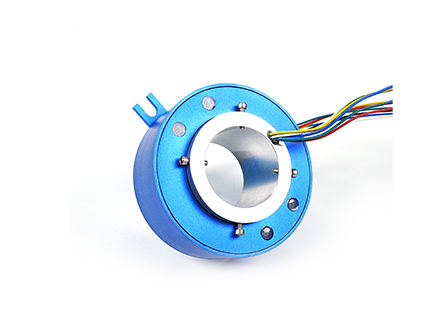
A wind turbine contains many rotating components, but some electrical systems must remain connected while these components rotate. A Slip Ring provides a continuous electrical connection between rotating and stationary parts, allowing power and signals to pass without restricting rotation.
Why Does a Wind Turbine Need a Slip Ring?
In a horizontal-axis wind turbine, the nacelle and rotor system operate while electrical and control components need to exchange power and signals. A conventional fixed cable cannot continuously rotate without becoming twisted or damaged.
A wind turbine slip ring solves this problem by maintaining electrical transmission between the rotating and stationary sections. It allows the required electrical power, control signals, and communication signals to pass through the rotating interface.
How Does a Wind Turbine Slip Ring Work?
A typical slip ring consists of rotating conductive rings, stationary brushes or contacts, insulation components, and a housing. The rotating part turns with the turbine while the stationary part remains fixed.
As the turbine rotates, electrical contacts remain connected with the conductive rings. This allows electrical current or signals to be transmitted continuously during rotation.
Where Is the Slip Ring Used in a Wind Turbine?
Slip Rings can be used in different rotating sections of wind turbine systems depending on the turbine design and electrical architecture.
Rotor electrical connection: Provides electrical transmission between rotating and stationary components.
Pitch control systems: Can transmit power and control signals to rotating pitch mechanisms.
Control and monitoring: Supports signal transmission from sensors and control devices.
Communication systems: Allows data and control signals to pass through rotating interfaces.
What Does a Slip Ring Transmit?
A wind turbine slip ring may be designed to transmit different types of electrical connections according to the system requirements.
| Transmission Type | Typical Function |
|---|---|
| Electrical Power | Supplies power to rotating electrical components |
| Control Signals | Transfers commands between control systems |
| Sensor Signals | Connects monitoring and measurement devices |
| Communication Signals | Supports data transmission between rotating and stationary systems |
What Are the Requirements for a Wind Turbine Slip Ring?
Wind turbines operate in demanding environments and may run continuously for long periods. Therefore, the slip ring needs to be designed according to the electrical, mechanical, and environmental requirements of the application.
Current and Voltage
The rated current and voltage should match the electrical load of the turbine system. Different circuits may require separate power and signal channels.
Rotation Speed
The slip ring should be suitable for the required rotational speed and duty cycle. Contact design and mechanical structure can affect service life and transmission stability.
Environmental Protection
Wind turbines may be exposed to moisture, dust, temperature changes, vibration, and other environmental conditions. The housing and sealing design should therefore be selected according to the installation environment.
Service Life
Because wind turbines are designed for long-term operation, contact reliability and wear resistance are important factors when selecting a slip ring.
How to Choose a Wind Turbine Slip Ring?
When selecting a slip ring for a wind turbine, engineers should consider:
Number of circuits
Rated current and voltage
Signal type
Rotational speed
Operating temperature
Protection requirements
Installation dimensions
Expected service life
Maintenance requirements
For customized wind turbine applications, these specifications should be evaluated together rather than selecting a slip ring based on current rating alone.
Custom Slip Ring Solutions
Slip ring manufacturers can develop customized assemblies according to the mechanical and electrical requirements of different rotating equipment. Circuit configuration, current rating, signal transmission, dimensions, connector type, housing, and protection level can be adjusted for specific applications.
For wind turbine manufacturers and system integrators, a properly matched slip ring can help maintain stable power and signal transmission while reducing problems caused by cable twisting and continuous rotation.
Conclusion
A slip ring in a wind turbine provides a continuous electrical connection between rotating and stationary components. It can transmit power, control signals, sensor signals, and communication signals while allowing the turbine system to rotate freely.
The right wind turbine slip ring should be selected according to the required electrical capacity, rotational speed, environmental conditions, installation space, and expected operating life.