
Slip rings are available in different designs to meet the electrical, mechanical, installation, and environmental requirements of rotating equipment. Different types of slip rings can be selected according to available installation space, number of circuits, rotational speed, current, signal type, and operating conditions.
Understanding the main types of slip rings can make it easier to select the appropriate design for industrial machinery, automation equipment, robotics, wind turbines, and other rotating applications.
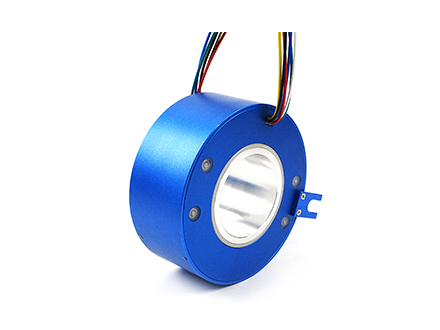
What Is a Slip Ring?
A slip ring is an electromechanical device that transfers electrical power and signals between a stationary component and a rotating component. It maintains electrical contact while allowing continuous rotation.
Different slip ring structures are designed for different installation requirements. The most common types include Capsule Slip Rings, through-bore slip rings, solid-shaft slip rings, Miniature Slip Rings, and waterproof slip rings.
1. Capsule Slip Rings
Capsule slip rings are compact slip ring assemblies designed for applications where installation space is limited. Their cylindrical structure makes them suitable for integrating into relatively small rotating systems.
Capsule slip rings are commonly used in automation equipment, camera systems, test equipment, rotary tables, and other applications requiring compact electrical rotary connections.
2. Through-Bore Slip Rings
Through-bore slip rings feature a central hollow shaft that allows cables, shafts, air lines, or other components to pass through the center of the slip ring.
This design is useful when the rotating equipment already has a central shaft or when other components need to pass through the center. Through-bore slip rings are commonly used in industrial machinery, rotary platforms, robotics, and automation systems.
3. Solid-Shaft Slip Rings
Solid-shaft slip rings use a solid rotating shaft and can be integrated into equipment where a hollow center is not required.
They can be selected for applications where the slip ring needs to connect directly with a rotating shaft or mechanical assembly. The mounting structure and shaft dimensions should be matched with the equipment.
4. Miniature Slip Rings
Miniature slip rings are designed for applications with strict space and weight limitations. Their compact size allows them to be integrated into smaller rotating mechanisms.
They can be used in compact automation equipment, optical devices, camera systems, sensors, robotics, and other applications where conventional slip rings may be too large.
5. Waterproof Slip Rings
Waterproof slip rings are designed for rotating equipment exposed to moisture, water, dust, or other demanding environmental conditions.
They can be used in outdoor machinery, marine equipment, industrial equipment, surveillance systems, and other applications where additional environmental protection is required.
6. High-Speed Slip Rings
High-speed slip rings are designed for rotating equipment that operates at relatively high rotational speeds. Their design needs to consider contact performance, mechanical structure, heat generation, and operating stability.
When selecting a high-speed slip ring, the actual operating speed and electrical requirements should be provided to ensure that the design is suitable for the application.
7. Power Slip Rings
Power slip rings are designed primarily for transferring electrical power between stationary and rotating components. They are available in different current and voltage configurations according to equipment requirements.
Power slip rings can be used in industrial machinery, rotating platforms, wind turbines, and other equipment requiring continuous power transmission during rotation.
8. Signal Slip Rings
Signal slip rings are designed to transmit electrical signals through rotating interfaces. They may be used for control signals, sensor signals, communication signals, or other low-power electrical connections.
For applications involving sensitive signals, factors such as electrical noise, contact resistance, signal integrity, and circuit configuration should be considered during selection.
9. Hybrid Slip Rings
Hybrid slip rings combine different transmission functions within a single rotary assembly. For example, one unit may integrate power circuits with signal or data transmission channels.
This type of design can help reduce installation space and simplify the electrical connection between stationary and rotating components.
How Do You Choose the Right Type of Slip Ring?
The appropriate slip ring type depends on the requirements of the complete rotating system. Before selecting a model, consider the following factors:
Installation space: Check the available diameter, length, and mounting area.
Center structure: Determine whether a hollow bore or solid shaft is required.
Current and voltage: Match the electrical ratings with the equipment requirements.
Number of circuits: Determine the number of power and signal channels required.
Rotational speed: Select a design suitable for the equipment's operating speed.
Signal transmission: Consider the required signal or data transmission characteristics.
Environmental conditions: Check whether protection against water, dust, temperature, or other conditions is required.
Mounting method: Make sure the slip ring can be properly integrated into the rotating assembly.
Slip Ring Types at a Glance
| Type | Main Feature | Typical Applications |
|---|---|---|
| Capsule Slip Ring | Compact cylindrical design | Automation, cameras, rotary equipment |
| Through-Bore Slip Ring | Central hollow bore | Industrial machinery, robotics, rotary platforms |
| Solid-Shaft Slip Ring | Solid rotating shaft | Rotary machinery and shaft-mounted systems |
| Miniature Slip Ring | Small size | Compact equipment and robotics |
| Waterproof Slip Ring | Environmental protection | Outdoor and moisture-exposed equipment |
| Hybrid Slip Ring | Multiple transmission functions | Complex rotating systems |
Conclusion
Different types of slip rings are designed to solve different rotary electrical transmission requirements. Capsule and miniature slip rings focus on compact installation, while through-bore and solid-shaft designs address different mechanical integration needs. Waterproof, high-speed, power, signal, and hybrid slip rings are selected according to specific operating requirements.
When choosing a slip ring, it is important to consider the mechanical structure, electrical specifications, rotational speed, environmental conditions, and installation method together. For specialized equipment, a customized slip ring can be developed around the actual requirements of the application.
FAQ
What are the most common types of slip rings?
Common types include capsule slip rings, through-bore slip rings, solid-shaft slip rings, miniature slip rings, waterproof slip rings, high-speed slip rings, and hybrid slip rings.
What is a through-bore slip ring used for?
A through-bore slip ring is used when cables, shafts, or other components need to pass through the center of the rotating assembly.
What is a capsule slip ring?
A capsule slip ring is a compact cylindrical slip ring designed for applications where installation space is limited.
Can one slip ring transmit both power and signals?
Yes. Hybrid slip ring designs can integrate power and signal circuits in the same rotary assembly, depending on the electrical and mechanical requirements.
How do I choose the right slip ring type?
Consider the installation space, bore or shaft structure, current, voltage, number of circuits, rotational speed, signal requirements, and environmental conditions before selecting a slip ring.
Need a Customized Slip Ring?
Different rotating applications require different electrical and mechanical configurations. Contact us with your current, voltage, circuit number, rotational speed, dimensions, and application requirements to discuss a suitable slip ring solution.