
When a machine rotates continuously, keeping electricity and signals moving between the stationary and rotating parts is not as simple as running a wire through the system. A conventional cable can twist, bend, and eventually fail if the rotating component keeps turning in the same direction.
This is the problem an electrical Slip Ring is designed to solve. Instead of allowing cables to carry the mechanical stress of continuous rotation, a slip ring creates a controlled electrical connection between a fixed part and a rotating part.
But how does an Electrical Slip Ring work in practice? The answer becomes much easier to understand when we look at what happens inside the component as the machine rotates.
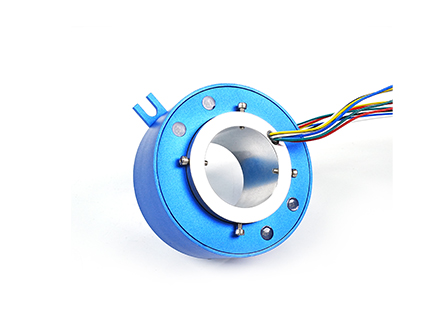
Start With the Problem: Electricity Meets Rotation
Most electrical connections are stationary. A power supply connects to a circuit board, a sensor connects to a controller, and a cable connects two fixed devices.
Rotating machinery creates a different situation.
Suppose a camera is mounted on a platform that needs to rotate 360 degrees. The camera requires power, while its control and video signals need to travel back to stationary electronics. If a normal cable is used between them, the cable will rotate together with the camera.
After enough rotation, the cable begins to wind around the shaft. Even a flexible cable has a limit to how much repeated bending and twisting it can tolerate.
A rotary electrical connector changes the arrangement. The mechanical rotation can continue while the electrical connection remains available through the rotating interface.
The Basic Working Principle of an Electrical Slip Ring
An electrical slip ring works by maintaining electrical contact between a stationary section and a rotating section.
A typical assembly contains a rotating component called the rotor and a stationary component called the stator. Conductive paths and electrical contacts are arranged between these two parts.
When the rotor turns, the conductive paths move relative to the stationary contacts. The contacts remain in contact with the corresponding conductive surfaces, creating a continuous electrical path.
This allows electrical power or signals to cross the rotating interface without requiring the external cable to twist around the machine.
In simple terms, you can think of a slip ring as an electrical bridge that stays connected while one side is turning.
What Happens Inside a Slip Ring?
Although the principle is straightforward, several components work together to make the connection possible.
Rotor: The Moving Side
The rotor is the part connected to the rotating equipment. When the machine rotates, the rotor rotates with it.
Depending on the product design, the rotor can be connected to a rotating shaft, platform, drum, robotic joint, or other moving assembly.
Stator: The Stationary Side
The stator remains fixed to the machine structure. It provides the connection between the slip ring and the stationary electrical system.
The relationship between the rotor and stator is important because the two must maintain the required mechanical alignment while allowing relative movement.
Conductive Rings
Conductive rings provide electrical transmission paths. A slip ring may contain several independent rings when the machine requires multiple circuits.
For example, one circuit could be used for power, another for a control signal, and additional circuits for sensors or other electrical functions.
Electrical Contacts
Electrical contacts maintain contact with the conductive rings while they rotate. Contact technology and material selection can have a significant influence on electrical stability, wear, noise, and service life.
This is one reason why the internal design of a slip ring connector matters just as much as its external dimensions.
Bearings and Mechanical Support
Bearings and other mechanical components allow the rotating assembly to move smoothly. They also help maintain the correct relationship between the rotating and stationary parts.
Insulation
Insulating components separate individual circuits and help prevent unwanted electrical contact between conductive paths.
How Power Moves Through a Slip Ring
Let's take a simple power-transmission example.
A stationary power source is connected to the stator side of the slip ring. The electrical path then passes through the contact interface to the conductive ring associated with the rotating side.
The rotating equipment is connected to the corresponding output circuit. As the rotor turns, the electrical contact remains available, allowing power to continue reaching the rotating equipment.
The important point is that the electrical connection does not need to rotate in the same way as a conventional cable. The mechanical movement occurs within the slip ring assembly while the conductive interface continues to transfer electricity.
How Does a Slip Ring Transfer Signals?
Power is only one possible use. Many rotating machines also need to exchange electrical signals.
For example, a rotating sensor may generate measurement data that needs to reach a stationary controller. The sensor can connect to one or more circuits inside the slip ring, allowing the signal to cross the rotating interface.
However, signal transmission is different from simple power transmission.
Low-level or high-speed signals can be more sensitive to electrical noise, contact resistance, impedance changes, and other factors. Therefore, a slip ring intended for signal or data transmission may require a different design from a product intended mainly for power.
Specialized electrical rotary connectors can be designed for applications that require both power and signal transmission.
Can One Slip Ring Carry Multiple Circuits?
Yes. A slip ring can contain multiple independent circuits within the same assembly.
This is particularly useful when a rotating machine needs several electrical functions at the same time.
For example, a rotating inspection system might need:
Power for the camera
Control signals for positioning
Sensor connections
Communication signals
Additional auxiliary circuits
Instead of installing several separate rotating electrical interfaces, multiple circuits can often be integrated into one slip ring according to the application's requirements.
Why Does Contact Design Matter?
The contact interface is one of the most important parts of an electrical slip ring because it experiences both electrical and mechanical activity during operation.
As the machine rotates, the contact surfaces move relative to each other. This creates friction and, depending on the design, gradual wear.
Contact material, surface treatment, contact pressure, rotational speed, electrical load, and environmental conditions can all influence performance.
For a simple power application, stable current transmission may be the primary concern. For a sensitive signal application, electrical noise and contact stability may be equally important.
That is why choosing an electrical slip ring should always start with the actual operating conditions rather than simply selecting a product based on its appearance.
What Determines Slip Ring Rotation Speed?
Not every slip ring is designed for the same rotational speed.
Higher rotational speeds can increase mechanical wear and influence heat generation and contact behavior. The bearing system, contact technology, internal structure, and overall mechanical design all need to be appropriate for the required RPM.
If a machine operates continuously at high speed, the slip ring should be selected according to both the normal operating speed and any expected peak speed.
How Does a Through-Bore Slip Ring Work?
A through-bore slip ring follows the same basic electrical principle but uses a different mechanical arrangement.
Instead of enclosing the entire center area, the unit contains a central opening. A rotating shaft, cable, or other mechanical component can pass through this opening.
This structure is particularly useful when the machine already has a central rotating shaft and the electrical interface needs to be installed around it.
The through-bore design can also simplify integration in certain industrial machines because mechanical and electrical components can share the same rotating axis.
Why Do Slip Rings Wear Out?
Traditional contact-based Slip Rings contain moving electrical interfaces, so wear is a natural consideration.
Several factors can influence service life:
Rotational speed
Number of operating hours
Electrical current
Contact material
Contact pressure
Environmental conditions
Vibration and mechanical alignment
Required number of circuits
A slip ring used occasionally in a clean indoor environment may experience very different conditions from one operating continuously in an industrial machine.
For this reason, the expected service life should be evaluated against the actual operating conditions instead of relying on a generic lifespan estimate.
What Can Affect Electrical Slip Ring Performance?
A slip ring may be mechanically suitable but still perform poorly if its electrical requirements are not properly matched.
Current Load
Higher current can increase heat generation and place greater demands on conductive components. The rated current of each circuit should therefore be checked carefully.
Voltage
The insulation system and electrical construction need to be appropriate for the operating voltage.
Electrical Noise
Applications involving sensitive signals may require careful consideration of contact technology and signal compatibility to minimize unwanted electrical interference.
Temperature
Temperature can influence materials, electrical resistance, lubrication, and mechanical performance. The operating temperature range should match the actual machine environment.
Vibration
Heavy machinery and mobile equipment may expose the slip ring to continuous vibration. Mechanical stability and mounting are therefore important considerations.
Where Is This Working Principle Used?
The basic working principle of an electrical slip ring can be applied to many types of rotating equipment.
Robotics
Robotic joints and rotating platforms may require power and signal transmission while moving through repeated or continuous rotation. A slip ring can help eliminate excessive cable twisting.
Rotating Cameras
Surveillance and inspection cameras can use slip rings to maintain power and communication connections while the camera rotates.
Wind Turbines
Wind turbines contain rotating assemblies that require electrical connections for control and monitoring systems. Slip ring technology can provide an interface between rotating and stationary components.
Industrial Automation
Rotary tables, automated inspection equipment, packaging machines, and other production systems may use slip rings when electrical connections must pass through a rotating interface.
Medical Equipment
Some medical imaging systems contain rotating assemblies that need power and signal transmission. In these applications, electrical stability and reliability are particularly important.
How to Tell Whether You Need a Slip Ring
There is a simple question that can help during the early design stage:
Does an electrical connection need to remain active while one part of the machine rotates?
If the answer is yes, a slip ring may be worth considering.
The next questions should be more specific:
Does the equipment rotate continuously or only through a limited angle?
How many electrical circuits are required?
How much current does each circuit need?
Does the system transmit power, signals, or data?
What is the operating rotational speed?
How much installation space is available?
Is a central shaft present?
What temperature, humidity, dust, or vibration will the component experience?
How long is the equipment expected to operate?
These answers provide a much better starting point for selecting a suitable rotary electrical connector.
FAQ About Electrical Slip Rings
Does an electrical slip ring rotate with the machine?
Part of the slip ring rotates with the machine while the other part remains stationary. The internal electrical interface allows the two sides to remain electrically connected during rotation.
Can a slip ring provide continuous power?
Yes. Slip rings can be designed to transfer electrical power continuously during rotation, provided the current, voltage, speed, and other operating conditions remain within the product's specifications.
Can an electrical slip ring transmit data?
Some specialized slip rings can transmit data and communication signals. The appropriate design depends on the signal type, frequency, bandwidth, and required transmission performance.
Why can't I simply use a flexible cable?
A flexible cable can work when the rotation is limited or intermittent. For continuous rotation in one direction, however, repeated twisting can eventually cause mechanical fatigue. A slip ring avoids making the cable carry that continuous rotational movement.
What is the main advantage of a through-bore slip ring?
The central opening allows a shaft or other component to pass through the slip ring, making this design convenient for machines built around a central rotating axis.
How can I improve the service life of a slip ring?
Use a slip ring that matches the required speed, current, voltage, environment, and mechanical installation. Proper alignment, suitable operating conditions, and following the manufacturer's specifications can also help maintain performance.
Final Thoughts
So, how does an electrical slip ring work? The basic idea is surprisingly straightforward: it maintains an electrical path between a stationary part and a rotating part through a controlled contact interface.
What makes the component valuable is not the electrical connection itself, but the fact that the connection can remain active while the machine continues to rotate.
That simple principle solves a common engineering problem in robotics, industrial automation, rotating cameras, wind turbines, medical equipment, and many other systems.
When selecting a slip ring, however, the working principle is only the starting point. Circuit quantity, current, voltage, rotational speed, signal requirements, mechanical dimensions, environmental conditions, and expected service life all need to match the application.
For standard equipment, an existing slip ring design may be sufficient. For specialized machinery, working with an experienced slip ring manufacturer can help develop an electrical and mechanical configuration that fits the rotating system more precisely.