Information
Focus on RHD Precision Industry - Get to know the new information of the industry quickly!


Focus on RHD Precision Industry - Get to know the new information of the industry quickly!
2026-06-12 09:54:31
In modern industrial automation and rotating machinery,reliable transmission of power and signals between stationary and rotating parts is essential.Traditional cables can easily become twisted,damaged,or disconnected when equipment rotates continuously.This challenge has led to the widespread use of Through Bore Slip Rings,a versatile electromechanical solution designed for continuous 360-degree rotation.
A Through Bore Slip Ring,also known as a hollow shaft slip ring,is a type of rotary electrical connector that allows electrical power,control signals,and data to pass from a fixed structure to a rotating component while maintaining uninterrupted operation.What makes it unique is the hollow center opening,or“bore,”which allows shafts,pneumatic tubes,hydraulic lines,and other mechanical components to pass through the middle of the device.
This design makes Through Bore Slip Rings one of the most popular choices in industrial automation,robotics,renewable energy systems,packaging equipment,and heavy machinery.
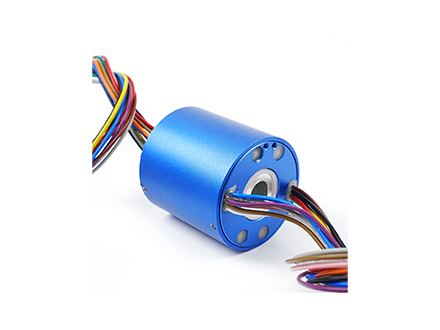
A through bore slip ring consists of two primary parts:
Rotor–The rotating section attached to the moving equipment.
Stator–The stationary section connected to the fixed structure.
Inside the slip ring are conductive rings mounted on the rotor and brushes attached to the stator.As the rotor turns,the brushes maintain constant contact with the rings,allowing electrical current and signals to flow continuously without interruption.
Unlike traditional wiring systems that twist and wear out during repeated rotation,a through bore slip ring enables unlimited rotational movement while preserving stable electrical connections.
The hollow center is one of its most important features.Depending on the application,the bore can accommodate:
Drive shafts
Hydraulic hoses
Pneumatic tubes
Fiber optic cables
Encoder cables
Mechanical couplings
This flexibility allows engineers to integrate multiple systems into a compact rotating assembly.
The central bore allows other mechanical or fluid-transfer components to pass through the slip ring,maximizing installation flexibility and reducing system complexity.
A through bore slip ring supports continuous rotation in either direction without causing cable entanglement or signal interruption.
Modern slip rings can transmit:
Electrical power
Analog signals
Digital signals
Sensor data
Industrial communication protocols
This capability makes them suitable for sophisticated automated systems.
Instead of requiring separate cable management systems,a through bore slip ring integrates power and signal transmission into a single device,saving valuable installation space.
High-quality brush materials and precision engineering enable many slip rings to operate for millions of revolutions before maintenance is required.
Manufacturers offer a wide range of customization options,including:
Bore diameter
Number of circuits
Current rating
Voltage rating
Protection level(IP rating)
Data communication protocols
Different applications require different slip ring designs.The most common types include:
These are used for general power and signal transmission in industrial machinery and automation equipment.
Designed for high-speed data communication,these models support Industrial Ethernet,Gigabit Ethernet,and other networking protocols.
Used in heavy-duty equipment where large amounts of electrical power must be transferred through rotating interfaces.
These advanced units transmit optical signals for applications requiring high bandwidth and low signal loss.
Hybrid designs combine electrical circuits with pneumatic channels,hydraulic passages,or fiber optic connections within a single assembly.
One of the biggest advantages is preventing cable damage caused by continuous rotation.
Stable electrical connections help reduce downtime and maintenance costs.
Power,control signals,and data can all be transmitted simultaneously through a single device.
The hollow shaft design accommodates various mechanical configurations and simplifies system integration.
Compared with traditional cable reels and rotating wire systems,through bore slip rings generally require less maintenance.
Continuous operation without cable limitations improves productivity in automated systems.
Through bore slip rings are widely used in automated production lines,indexing tables,and rotary assembly machines where continuous rotation is required.
Many robotic systems rely on slip rings to provide uninterrupted power and communication during rotational movements.
Wind energy systems use through bore slip rings to transfer power and control signals between rotating blades and stationary monitoring equipment.
Rotary filling,labeling,and packaging machines often utilize slip rings to maintain continuous operation at high speeds.
Advanced imaging systems,including CT scanners and rotating diagnostic devices,use slip rings for stable signal and power transmission.
Pan-tilt-zoom(PTZ)cameras and radar systems require continuous rotation and dependable signal transfer,making slip rings an ideal solution.
Cranes,excavators,and rotating platforms use through bore slip rings to deliver power and control signals while allowing unrestricted rotation.
Solar tracking systems and other renewable energy technologies also benefit from the flexibility and reliability of through bore slip rings.
When selecting a slip ring,engineers often compare through bore slip rings with Capsule Slip Rings.
A capsule slip ring is generally smaller and more compact,making it suitable for applications with limited installation space.However,it lacks the hollow center that characterizes a through bore design.
Through bore slip rings offer greater flexibility because they allow shafts and fluid lines to pass through the center.They also typically support higher current capacities and are better suited for industrial environments.
If a rotating shaft or central passage is required,a through bore slip ring is usually the preferred choice.
Factors to Consider When Choosing a Through Bore Slip Ring
Selecting the right slip ring depends on several factors:
Bore Size
The bore diameter must accommodate the shaft,hose,or cable bundle passing through the center.
Electrical Requirements
Consider voltage,current,and the number of circuits needed for the application.
Rotational Speed
Different slip rings are designed to operate at specific RPM ranges.
Environmental Conditions
Dust,moisture,vibration,and temperature extremes may require special protective features or higher IP ratings.
Signal Type
Determine whether the application requires analog signals,digital communication,Ethernet,fiber optics,or a combination of these.
Service Life Expectations
For demanding industrial applications,selecting a slip ring with a longer operational lifespan can reduce maintenance costs and downtime.
A through bore slip ring allows electrical power,signals,and data to be transmitted across a rotating interface while providing a central opening for shafts,hoses,or cables.
Yes.Many models support Ethernet,USB,CAN Bus,RS485,Profibus,and other industrial communication protocols.
Yes.Many manufacturers offer sealed models with high IP ratings for outdoor and harsh-environment applications.
Service life depends on operating conditions,but quality units can often achieve tens of millions of revolutions with proper maintenance.

Phone: +86 13622631318
Email:info@reehonde.com
Add: Room 301, Building 1, No. 11, Dalingshan Lakeside South 1st Street, Dalingshan Town, Dongguan City, Guangdong Province, China
Copyright © 2026 Dongguan Rui-Hong-De Precision Industry Co., Ltd All rights reserved. Privacy policy | Terms and Conditions


