Information
Focus on RHD Precision Industry - Get to know the new information of the industry quickly!


Focus on RHD Precision Industry - Get to know the new information of the industry quickly!
2025-12-09 17:17:57
Rotary motion is essential in countless machines—manufacturing robots, printing equipment, winders, conveyors, packaging machines, and high-speed spindles all rely on components that can rotate while transferring fluids or signals. But how do these machines manage to move continuously while still delivering hydraulic oil, coolant, steam, air, or data through a rotating interface?
The answer is a specialized device known as a rotary union.
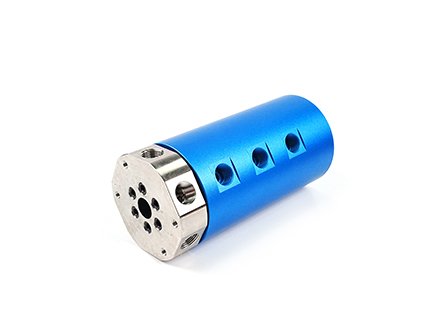
A rotary union—also called a rotary joint or rotary union joint—is a mechanical device that allows the transfer of fluids between a stationary source and a rotating machine part. The fluids can include:
water
hydraulic oil
coolant
steam
compressed air
vacuum
chemicals
In simple terms, a rotary union enables a machine to rotate 360 degrees continuously while still maintaining a leak-free internal passage for fluid transfer.
If you are wondering “what is a rotary union?”, the simplest definition is:
A rotary union is a sealing device that connects a rotating component to a stationary supply line, enabling fluid, gas, or media to pass through without leakage despite continuous rotation.
Rotary Unions serve hundreds of engineering applications. Understanding what is a rotary union used for helps clarify why they are so critical.
Machines that require rotating cylinders or actuators often use a hydraulic rotary union to transfer pressurized oil.
Typical examples:
excavator swivels
hydraulic presses
injection molding machines
mobile cranes
robotics wrists and joints
High-speed spindles use rotary unions to transfer:
coolant
lubrication
air for tool clamping
Rotary unions deliver ink, adhesives, or air to high-speed rollers while maintaining consistent pressure.
Steam or heated water is delivered to rotating drums such as dryers, cookers, and blanchers.
Rotary joints deliver hydraulic pressure, cooling liquid, or signals in turrets, radar systems, and missile launchers.
Rotary unions transfer temperature-controlled water or oil in film extruders and calender rollers.
In short, rotary unions are used wherever rotating components require media transfer under pressure, temperature, or speed.
Understanding the internal components helps explain how a rotary union works.
A typical rotary union contains:
This connects to the fixed supply line and holds the internal sealing system.
This attaches to the rotating equipment—rollers, spindles, or drums.
These support smooth rotation and alignment between rotor and housing.
The most critical part. Common seal types include:
mechanical seals
carbon graphite seals
O-rings
lip seals
tungsten carbide seals
The seal keeps fluids inside the passage while allowing rotation.
Channels that guide media through the rotary union joint.
Maintain sealing pressure even at high speed or variable load.
The basic operation is simple but highly engineered.
Hydraulic oil, air, steam, or coolant flows into the inlet of the housing.
Mechanical seals or carbon graphite seals create a low-friction seal between the stationary housing and the rotating shaft.
The seal is the heart of the system.
Attached to a shaft, drum, or spindle, the rotor rotates at varying speeds—sometimes up to 20,000 RPM.
Because the seal is designed for friction reduction and heat dissipation, it stays leak-free.
Fluid continues through internal passages and exits into the rotating equipment.
The rotary union maintains:
sealing integrity
pressure stability
smooth rotation
even as the machine runs continuously.
A rotary union works by maintaining a high-precision, low-friction seal between stationary and rotating parts, enabling fluid to pass through without leakage despite movement.
There is no single type of rotary union. They vary by fluid, pressure, speed, and application.
A hydraulic rotary union is designed specifically for hydraulic oil under high pressure (up to 5000 PSI or higher).
Features:
heavy-duty steel or stainless steel
advanced mechanical sealing
multiple channels for multi-function circuits
Used in:
excavators
lifting equipment
wind turbines
heavy robotics
Used in CNC spindles and machine tools.
Characteristics:
high RPM capability
balanced rotor
coolant-through-spindle support
These allow multiple independent media channels such as:
oil + air
vacuum + water
coolant + hydraulic oil
Each channel is sealed separately.
A Rotary Slip Ring is similar in purpose but transfers electrical signals or power, not fluids.
Used in:
wind turbines
surveillance cameras
radar systems
aerospace systems
A fiber optic slip ring transfers optical signals through a rotating interface without interrupting data flow.
Benefits:
no electrical noise
ultra-fast communication
zero interference
Used in:
medical imaging
military radar
satellite communication systems
Although they serve a similar purpose, their functions differ.
| Feature | Rotary Union | Rotary Slip Ring | Fiber Optic Slip Ring |
|---|---|---|---|
| Media Type | Fluids / gases | Electrical power & signals | Optical signals |
| Common Use | Hydraulic oil, water, coolant | CCTV, wind turbines | High-speed data |
| Construction | Mechanical seals | Electrical contacts | Optical alignment |
| Combination | Possible (fluid + electrical) | – | – |
Many advanced systems combine fluid transfer and electrical data transfer using hybrid assemblies.
Engineers must consider:
Coolant, steam, hydraulic oil, or air require different seal designs.
Hydraulic applications require stronger seals than low-pressure air systems.
High-speed CNC unions use special balancing and cooling methods.
Steam and hot oil need thermal-resistant materials.
Robotics and automation often require several channels for different media.
Common materials include:
brass
stainless steel
carbon steel
ceramic
graphite
Rotary unions are essential in any machine requiring rotation plus fluid transfer.
Continuous 360° rotation
Leak-proof transfer of media
Long lifespan with low maintenance
Stable pressure control
Compatibility with high temperature and high pressure
Support for multi-passage channels
Can be integrated with slip rings for hybrid use
A rotary union is a deceptively simple yet technologically advanced component that keeps modern machinery running. By providing a rotating, leak-free interface for transferring liquid, gas, or steam, it enables high-performance automation across many industries.
In summary:
If you need to know what is a rotary union, it is a mechanical device that transfers fluids between stationary and rotating components.
If you are asking what is a rotary union used for, the answer is: any application where fluids or gases must pass through a rotating machine element.
Rotary unions are available in many forms, including specialized types such as hydraulic rotary union, multi-passage units, and hybrid forms combined with rotary slip rings or fiber optic slip rings.
Understanding how a rotary joint works helps engineers choose the right design for pressure, temperature, fluid type, and rotational speed.
With the right rotary union joint, machines achieve higher productivity, greater reliability, and longer service life.

Phone: +86 13622631318
Email:info@reehonde.com
Add: Room 301, Building 1, No. 11, Dalingshan Lakeside South 1st Street, Dalingshan Town, Dongguan City, Guangdong Province, China
Copyright © 2026 Dongguan Rui-Hong-De Precision Industry Co., Ltd All rights reserved. Privacy policy | Terms and Conditions


